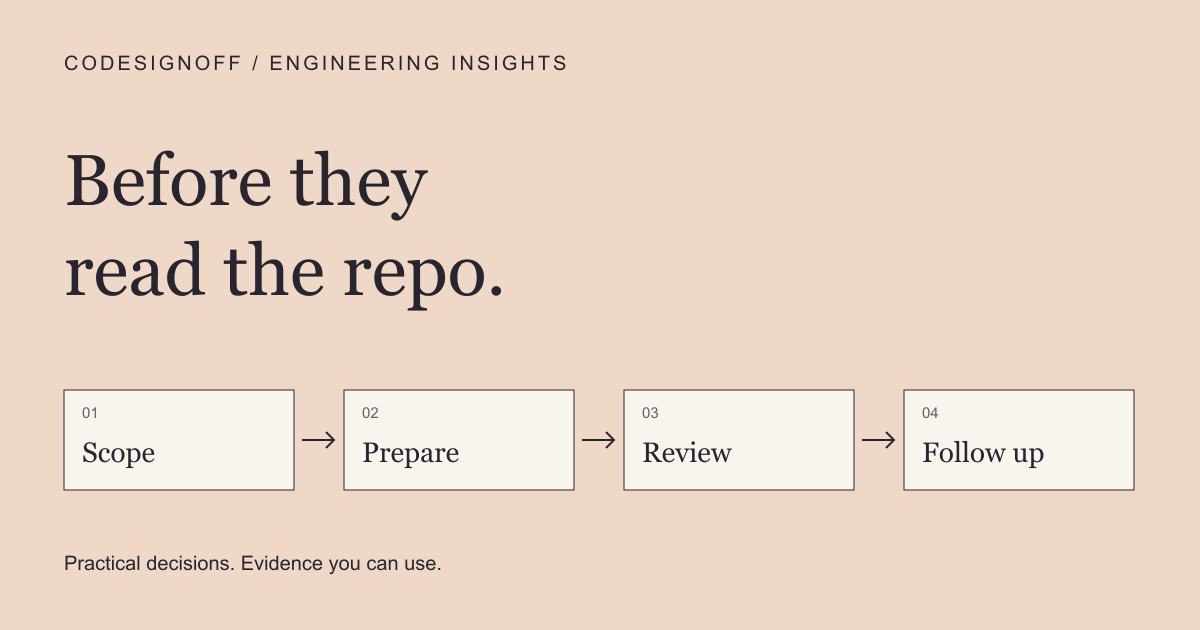
Agree what the review needs to answer
“Can we see the code?” is not yet a scope. Ask whether the reviewer is assessing maintainability, security, delivery capability, ownership or the ability to support a particular roadmap. Record repositories, environments and the revision under review. Confirm who will receive access and how long it is needed. These are practical preparation steps, not a universal investor checklist: the transaction and reviewer determine the actual questions. Where confidentiality or contractual obligations are involved, use your organisation’s established approval process.
Prepare an index that points to evidence
A useful index is a map, not a document dump. For each important claim, give the reviewer an artefact, an owner and its date or revision. If you claim deployment is repeatable, link the pipeline and a recent result. If you claim backups support recovery, provide a restore exercise rather than a screenshot showing backups enabled. NIST’s SSDF offers a common language for secure development practices, but using its headings does not certify a product. Describe what operates in your system today.
Keep access deliberate and limited
Use named accounts and the least access needed for the agreed review. Read-only repository access may be appropriate for initial inspection; it does not automatically grant a reason to expose production customer data or credentials. Check the repository and supporting material for secrets before sharing. Avoid emailing database dumps as a shortcut to explaining the data model. Arrange a controlled walkthrough when an operation cannot be reproduced safely outside production. Set an owner and end date for access removal after the review.
Illustrative evidence entry: can another engineer release?
Consider a hypothetical product where only its original developer can deploy. The evidence entry should say so plainly. Record the documented deployment steps, the last successful run, required permissions and the missing handoff. A second engineer can then attempt a non-production release and record where they get stuck. That gives the reviewer a concrete operational risk and a verifiable improvement path. A slide saying “automated DevOps” obscures the problem if the automation still relies on undocumented credentials or manual actions.
Make the known-risk register useful
Include inconvenient facts while you still have time to explain them. Separate a reproduced defect from a concern that has not been tested. Give each entry a consequence, an owner and a proposed action. Do not present an estimate as a committed completion date unless somebody has accepted the work. The reviewer may disagree with priorities; that is easier to resolve when the evidence is accessible. OWASP’s testing guide is a reference for security-testing scope, not a replacement for the reviewer’s wider architecture and business questions.
A preparation checklist for the review room
Walk through this list with the technical owner before the meeting. Where evidence does not exist, mark the gap rather than manufacturing a document that implies a process has already operated.
- Architecture and data-flow explanation consistent with the current deployment.
- Repository, revision, build instructions and dependency ownership identified.
- Test results linked to a revision, with failed or excluded areas explained.
- Deployment and recovery evidence, including manual steps and access owners.
- Known risks, open questions and a controlled process for follow-up access.
Sources & further reading
Reference material for the guidance and examples above. Where included, community discussions provide context rather than verified incident evidence.
Prepared with AI assistance using the official references below. Worked examples are illustrative, not client case studies. The practical checklists are CodeSignOff editorial guidance, not certification criteria.
About CodeSignOff Editorial
CodeSignOff Editorial publishes engineering guidance for founders evaluating AI-built software. CodeSignOff is a product of Avi Root Info Solutions, led by Shekhar Juneja, whose software career began in 1998 and includes architecture for UK mortgage and credit-rating systems. This organisational byline does not indicate a personal review of this article by Shekhar.
Engineering background and editorial approach · Shekhar’s professional profile ↗
Evidence to take into your own review
Define the code revision and scope. For each finding, record the affected flow, the steps that reproduce it, its business consequence and the evidence for the next action. After a fix, repeat the check and record what remains uncertain. An audit delivers a verdict; remediation and verification are separate steps.
This article is general engineering guidance. It does not establish the security or compliance of your application. Contact us with a correction or a question about the guidance.